THE PREVENTION ESSENTIALSTwo ways to provide passive protection.
Use the pathway for a patient-specific recommendation. These summaries support counselling and planning.
01 / DURING PREGNANCYMaternal RSV vaccination
28–36 weeks’ gestation in the South African product information
Offer year-round in the recommended window. A single 0.5 mL intramuscular dose of the maternal RSVpreF vaccine is used after reconstitution.
The mother produces antibodies that cross the placenta. The infant is born with passive protection.
View maternal recommendation figure ↗02 / AFTER BIRTHInfant monoclonal antibody
Before / during the local RSV season
Assess maternal vaccination and timing, prior monoclonal doses and the local season. For eligible infants and high-risk children, Figure 3 uses weight-based nirsevimab dosing: under 5 kg, 50 mg; 5 kg or more, 100 mg IM once.
High-risk children aged 12 to under 24 months follow the same weight bands in the statement. The statement notes approval pending for this age group at publication; confirm current local prescribing requirements.
View infant recommendation figure ↗ HOW MATERNAL PROTECTION WORKSFrom mother to infant.
Vaccination → maternal antibody response → placental transfer → passive infant protection.
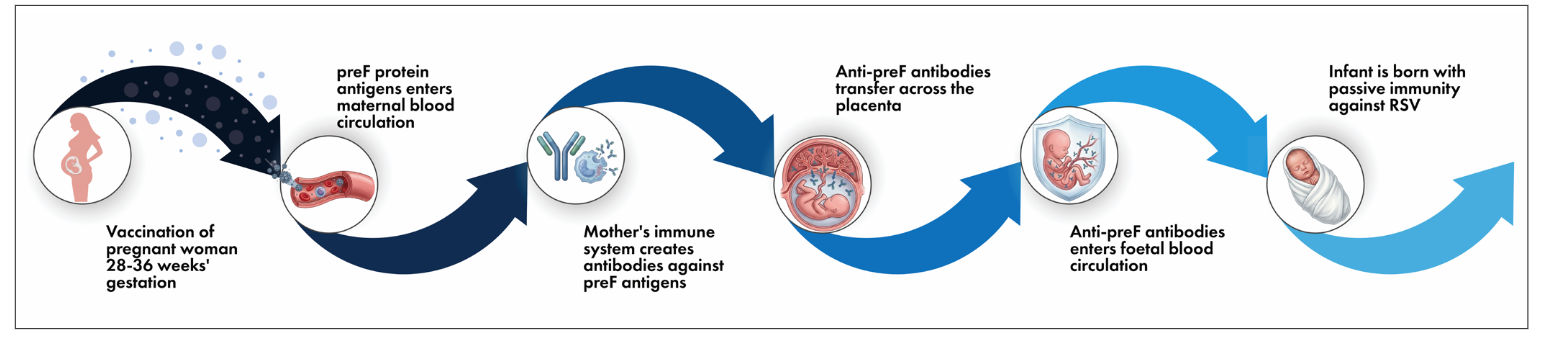
Timing matters. The pathway uses an interval of at least 14 days between maternal vaccination and birth, following the article text. If the interval was shorter or the history is unknown, assess the infant route.
Figures reproduced from the supplied 2026 joint statement by Demopoulos and colleagues (Fig. 1 adapted in the article from Patel et al.). CC BY-NC 4.0. Open a figure to view it at full size.
SOURCE & SCOPEGuidance you can inspect.
Based on the South African joint statement and checked against the retrieved South African professional information.
PRIMARY CLINICAL SOURCE · PUBLISHED 21 OCTOBER 2026Joint statement for the prevention of respiratory syncytial virus in young infants in South Africa
Demopoulos D, du Plessis N, Wise A, Masekela R, Dangor Z. Afr J Thorac Crit Care Med. 2026;32(3):e4934.
Product-specific prescribing
Generic prevention labels are used in the pathway. The displayed maternal dose is for RSVpreF (Abrysvo); infant weight-band dosing is for nirsevimab. These are not interchangeable with other products. The South African Abrysvo professional information states weeks 28–36.
Maternal vaccine: SAHPRA PI ↗Nirsevimab: SAHPRA PI ↗Older high-risk children
The statement lists congenital heart disease with haemodynamic significance, chronic lung disease, HIV, inborn errors of immunity, secondary immune deficiency, and neurological or neuromuscular disease.
Figure 3 is the dosing source for this tool: under 5 kg, nirsevimab 50 mg IM once; 5 kg or more, 100 mg IM once. The figure applies these bands to eligible infants and high-risk children aged 12–24 months without a separate first- or second-season regimen. Its footnote states SAHPRA approval pending for 12–24 months at publication. Confirm current local prescribing requirements.
Seasonality and implementation choices
The article describes February–May as the usual South African season, subject to local variation. Its figure uses administration shortly before or during the season. The text also discusses an alternative routine birth-dose programme from August/September to May. The latter is shown as a planning consideration, not assumed to be national policy or an active local programme.
Use chronological age at the intended administration date. Reassess infants awaiting the next season, as eligibility may change. Product access and funding must be confirmed locally.
Before administration and aftercare
Confirm the correct product, prior doses, eligibility, contraindications, dose, route, consent, stock and local policy. Check hypersensitivity history; consider bleeding disorders and product-specific precautions. For maternal vaccine, review acute febrile illness, obstetric factors and the recommended interval from Tdap in current professional information.
Document product, dose, date, batch and site in the maternal or child record. Ensure readiness to treat anaphylaxis. Counsel on expected reactions and report suspected adverse reactions through local and SAHPRA channels.
The statement discusses a preterm-birth imbalance in the maternal vaccine trial, including a signal at South African study sites. Provide balanced counselling and follow local obstetric guidance rather than describing the intervention as risk-free.
How to use this tool
This is clinician decision support for prevention, not an acute RSV assessment or treatment tool, prescribing order, or substitute for clinical judgement. No patient identifiers are requested. Answers stay in the current page’s memory, are not saved to local storage and are cleared on refresh or “New patient”.
Sources reviewed 28 October 2026. This tool does not monitor changes in product approval, drug availability or RSV surveillance automatically. Verify current professional information and institutional guidance before administration.